
Geography
Intent
At Ladysmith Junior School, we follow the National Curriculum to structure and shape our teaching of geography. We aim to provide a high-quality geography education that inspires curiosity and fascination about the world and its people. This principle guides our provision, ensuring pupils develop a secure understanding of the places, processes and patterns that shape our world, as well as the ways in which people interact with their environments.
Through our geography curriculum, we aim to:
- Inspire children’s curiosity to enquire about the world and to ask and investigate meaningful geographical questions.
- Teach the geographical knowledge, understanding and disciplinary skills outlined in the National Curriculum through clearly structured and progressive sequences of learning.
- Develop children’s understanding of key geographical vocabulary and enable them to use this vocabulary to explain, reason and justify their geographical ideas.
- Provide all children with accessible opportunities to explore places, themes and issues through a range of enquiries, enabling them to collect, interpret and use evidence to reach explanations and conclusions.
- Enable children to see themselves as geographers who can apply their skills and knowledge to understand the wider world, now and in the future.
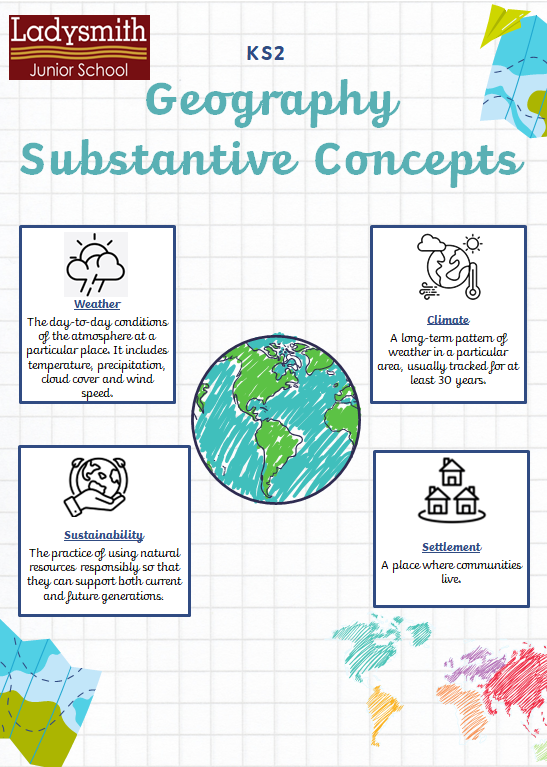
Our curriculum is linked together by four key substantive concepts. These are the 'big ideas' of geography, which are revisited in different contexts enabling children to build ever stronger connections with their prior learning.
What do geography lessons look like at Ladysmith Juniors?
We use our progression map to ensure learning builds securely year on year and lesson on lesson. Each sequence of learning begins with an overarching enquiry question, so pupils understand the purpose and direction of their learning. Lessons begin with carefully selected rewind questions to help children retrieve and connect prior knowledge.
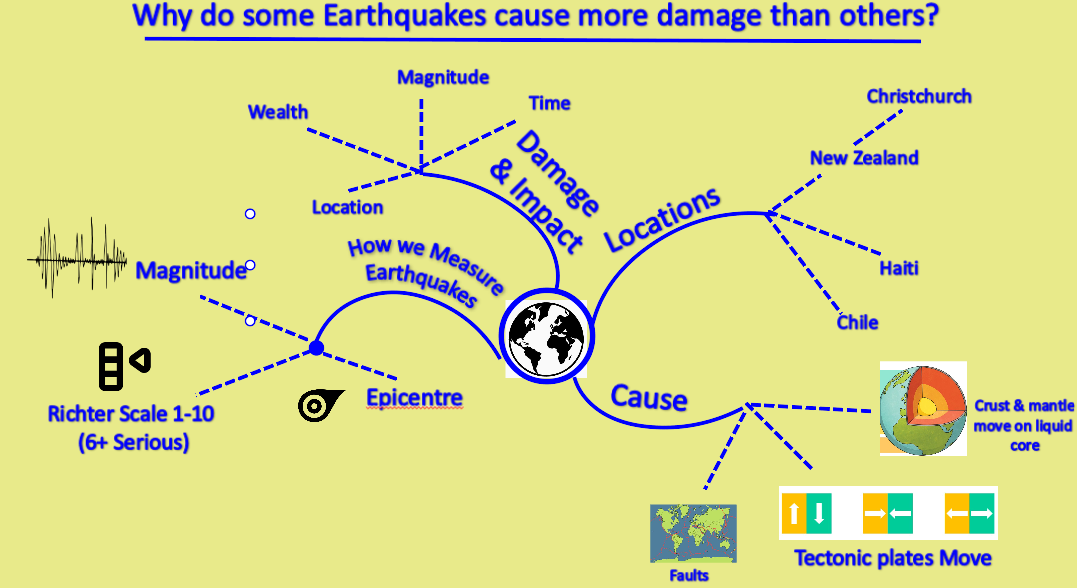
We use schema containing key vocabulary, images and information to highlight the knowledge pupils will acquire across the sequence. This supports dual coding, helping pupils remember more, make stronger connections and commit learning to long-term memory. Schema are revisited at the start of every lesson to strengthen recall and fluency. An example of a schema used in Year 4 is below:
Explicit teaching of geographical vocabulary features in every lesson, with regular opportunities for pupils to hear, practise, apply and refine their use of subject-specific language.
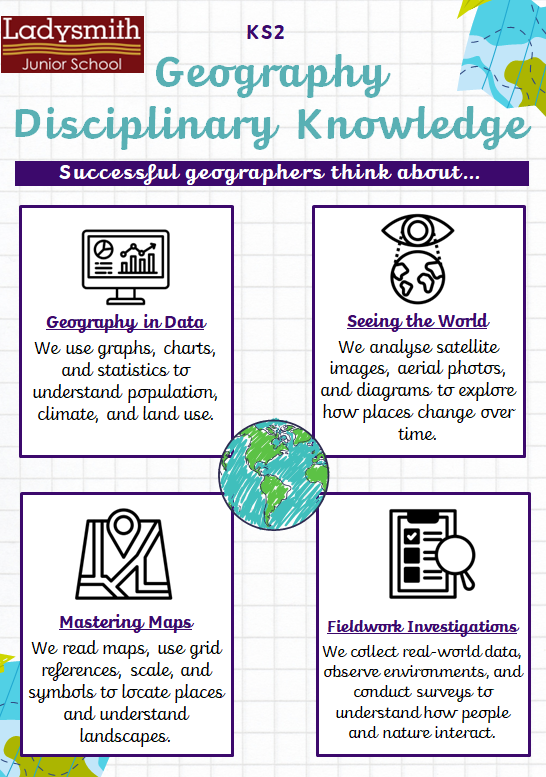
Our lessons also focus on disciplinary geography. We break down and sequence the ‘Working Geographically’ skills across Key Stage 2 so that children can engage in meaningful geographical enquiry. Lessons may involve analysing maps, using satellite imagery or GIS, conducting fieldwork, interpreting data, examining photographs, exploring case studies, discussing different perspectives or carrying out research. We want pupils to engage in creative, critical and analytical thinking in every lesson.
How do we make sure that every child succeeds?
Our curriculum is designed to be inclusive and accessible for all learners. Planning is carefully adapted to ensure all children can engage meaningfully with geographical learning and demonstrate their understanding. Each unit provides a range of opportunities for pupils to show what they know—for example through maps, diagrams, models, photographs, field sketches, oral explanations or group discussions.
We continually assess pupils throughout teaching, addressing misconceptions and providing additional support where needed. End-of-unit assessments give pupils the opportunity to demonstrate their understanding and ensure that teachers are able to provide additional support to any child who has not yet secured the key learning.
| Subject Documents |
|---|
| Ladysmith Geography Progression |