
Design Technology
Intent
At Ladysmith Junior School, we follow the National curriculum to structure and shape our teaching of Design and Technology. Subsequently, and as outlined in the curriculum, we aim for pupils to learn how to take risks, becoming resourceful, innovative, enterprising and capable citizens. Through the evaluation of past and present design and technology, pupils develop a critical understanding of Design and Technology’s impact on daily life and the wider world. Through our curriculum pupils will:
- develop the creative, technical and practical expertise needed to perform everyday tasks confidently and to participate successfully in an increasingly technological world
- build and apply a repertoire of knowledge, understanding and skills in order to design and make high-quality prototypes and products for a wide range of users
- critique, evaluate and test their ideas and products and the work of others
- understand and apply the principles of nutrition and learn how to cook.
What do Design and Technology lessons look like at Ladysmith Juniors?
At Ladysmith Junior School, we use our progression map to make sure that our lessons build year on year and lesson on lesson. We use schema, which contains text and images to describe the key knowledge children will acquire during the sequence. We use schemas to support dual coding of new information, supporting pupils to remember more, and make stronger connections with what they already know. This helps children to commit their new learning to long term memory. Learning in Design and Technology is separated into practical skills and technical knowledge and both areas are clearly outlined on schemas. The schema is revisited at the beginning of every lesson, prompting the children to recall their new knowledge regularly. Another tool that is used to help children to build on their existing knowledge, is the practise of recalling carefully selected questions at the beginning of each lesson. Below is an example of a schema used in Year 3:
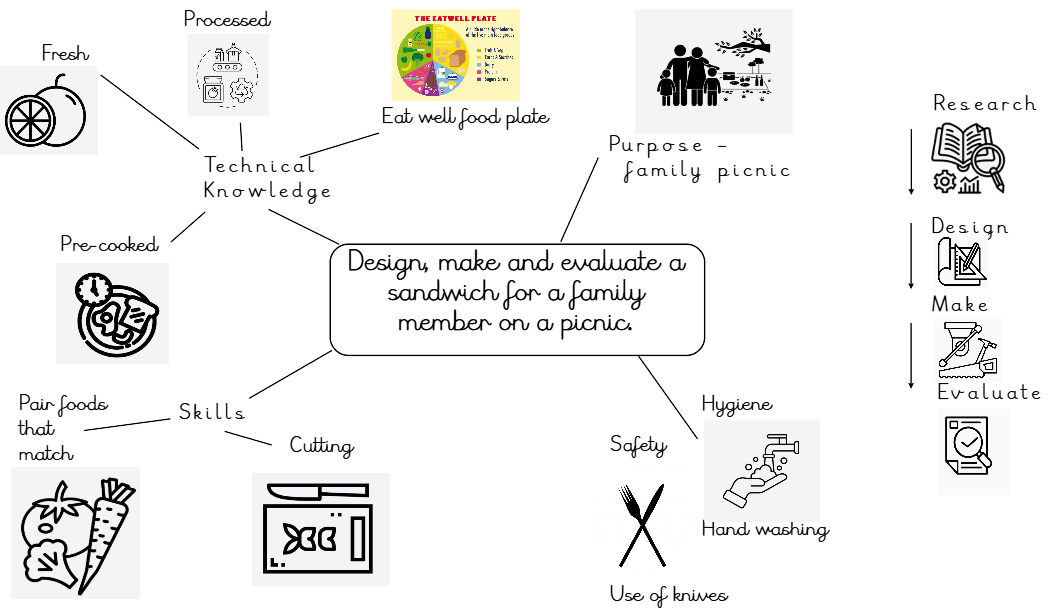
Every unit of Design and Technology starts with the children receiving a design brief. These briefs are specific to a real-world context and, where possible, reflect the unique context of Ladysmith. For example, our Year 5 children working to the following brief: ‘Design, make and evaluate an enrichment structure for the school goats’. Children then develop a design criteria, which outlines what they are making, what materials and time they have available and what specifications their product needs to have or be. Constant evaluation against these criteria form a key component of the iterative cycle, which runs through each unit. The iterative cycle follows the cycle of: Product Research, Design, Make and Evaluate. Whilst all of the aspects of the cycle are important, we put additional emphasis on evaluation, recognising the impact this has on pupils’ ability to think critically.
We recognise that Design and Technology is a practical subject and all sequenced units of learning involve a focussed practical task which equips pupils with the skills they require to successfully satisfy their original brief.
How do we make sure that every child succeeds?
Our curriculum is designed to be inclusive for all so our planning is carefully adapted to ensure that all children have the opportunity to demonstrate their understanding and practical abilities to the best of their abilities. This includes adapted equipment and careful attention to supporting individual sensory needs. Each sequence of learning in Design and Technology will provide a diverse range of learning outcomes for our pupils. For example, some lessons may involve taking photos, sorting objects, group discussion or drawing a diagram.
| Subject Documents |
|---|
| Ladysmith DT Curriculum Progression 25 26 UPDATED |